The moment you start checking out the clothing stalls at Kalagram, you’ll be surprised to see the diversity in India’s clothing styles and traditions. Look at a Bandhani dupatta from Rajasthan, and just next to it, you’ll see a silk border woven stole from a completely different state.
That’s the variety you find in traditional clothing of India, where every region has its own fabric, its own weave, and its own reason for wearing it.
Climate and temperature also play a lot of roles here. In this blog, you will learn about the major Indian clothing categories for both women and men you’ll actually find at an artisan market like Chokhi Dhani Kalagram.
What Shapes Traditional Clothing of India
Fabric choice takes place because of the climate and seasons. Wool and Pashmina belong to Kashmir because winters there are long and difficult to stand. Cotton dominates Kerala and the coastal states because the air stays humid most of the year. Rajasthan leans on Bandhani tie-dye and mirror work because bright colour cuts through desert light. Once we understand this logic, we realise the importance of these Indian clothing traditional variants according to different regions.
Traditional Dresses for Women
1. Saree
Saree is a five to nine yards long piece of unstitched fabric that truly enhances the beauty and grace of every Indian woman when draped properly with a fitted blouse and petticoat. It comes in a variety of designs, fabrics, and woven styles. A Banarasi saree from Uttar Pradesh carries dense gold and silver zari work, heavy enough that brides still choose it for their weddings. Move south to Tamil Nadu and you get the Kanchipuram, also known as Kanjeevaram saree, made from thicker silk, contrast borders, built for temple visits as much as wedding mandaps. Maharashtra’s Paithani saree looks extraordinary with peacock-motif borders- rare to find anywhere else in the country.
Fabric varieties: Banarasi silk, Kanchipuram silk, Paithani silk
Regional styles: Uttar Pradesh (Banarasi), Tamil Nadu (Kanchipuram), Maharashtra (Paithani)
Best for: Weddings and formal wear (Banarasi, Kanchipuram); festive and cultural occasions (Paithani)
2. Lehenga / Ghagra Styles
Rajasthan and Gujarat share a border and, thus you can find similarity in the silhouette. Rajasthan’s Ghagra Choli pairs a flared skirt with a fitted blouse and odhni, usually in Bandhani or Kota Doria, and comes out for Teej and Gangaur. It is a famous outfit to be worn in North India for occasions like sangeet, mehendi functions, cocktail evening parties, etc. Gujarat’s Chaniya Choli looks similar but it is made from Patola silk or Bandhani to move freely, because Navratri means hours of garba dancing in it.
Fabric varieties: Bandhani, Kota Doria, Patola silk, cotton
Regional styles: Rajasthan (Ghagra Choli), Gujarat (Chaniya Choli)
Best for: Teej and Gangaur (Rajasthan); Navratri and weddings (Gujarat)
3. Mekhela Chador
In Assam, women don’t wear a single-drape saree. The Mekhela Chador is a two-piece set- a wrapped bottom skirt paired with an upper wrap, usually woven in Muga or Eri silk, both native to the region and rarely seen elsewhere in the country.
Fabric varieties: Muga silk, Eri silk, Pat silk, cotton
Best for: Bihu festival, weddings, and formal occasions
4. Pheran (Women’s)
In Jammu & Kashmir, clothing heavily depends on the season before thinking about the occasion. The Pheran is a loose overgarment in wool or Pashmina, designed to make long winters bearable. They come in a variety of designs to be worn in weddings and festive occasions when you don’t want to compromise with your look and style.
Fabric varieties: Pashmina, wool, silk, Tweed
Best for: Winter wear; weddings and festive occasions
5. Salwar Kameez
This is probably the most-worn traditional outfit in the country, and it doesn’t belong to any one state the way a Kanchipuram saree belongs to Tamil Nadu. It is a three-piece outfit with a tunic(kurta), loose trousers(salwar), and a dupatta(optional). From Punjab to Delhi to Rajasthan to Kashmir, this traditional attire of India is worn by women of all age groups and regions. changing weight and fabric depending on whether it is worn in an office or a wedding. If you are fond of Lucknawi chikankari or Kashmiri embroidered suits, you can visit the best Jaipur shopping market, i.e., Chokhi Dhani Kalagram.
Fabric varieties: Cotton, georgette, chiffon, silk, velvet, linen
Best for: Daily wear (cotton, georgette); festive and wedding occasions (silk, velvet, heavier embroidery)
6. Kurta Set
A kurta(long or short) paired with palazzos, straight pants, or a skirt has become an everyday traditional wear across urban India. Mostly, the cotton and khadi fabrics are used to wear for daily office use, keeping it breathable throughout.
Fabric varieties: Cotton, khadi, linen, chanderi, silk, georgette
Best for: Daily wear, casual festive occasions, office wear
Traditional Attire for Men
1. Dhoti-Style Attire
In Rajasthan, men pair the Angarkha with a Dhoti and Safa – a wrap-front upper garment and a turban that changes colour by district. Tamil Nadu keeps things simpler with the Veshti and Angavastram, plain cotton for daily wear and silk-bordered versions for weddings. Maharashtra’s Dhotar comes with a Kurta and Pheta. Cotton fabric is preferred for most days and Paithani silk for festival season.
Fabric varieties: Kota Doria, Kanchipuram silk, Paithani silk, cotton
Regional styles: Rajasthan (Angarkha), Tamil Nadu (Veshti), Maharashtra (Dhotar)
Best for: Daily wear (cotton versions); weddings and festivals (silk versions)
2. Kurta-Pajama / Sherwani
In Indian ethnic clothing, men are fond of this category. The Kurta-Pajama covers daily wear; the Sherwani, in brocade or silk, takes over once wedding season starts.
Fabric varieties: Cotton, Khadi, silk, brocade
Best for: Daily wear (Kurta-Pajama); weddings and formal events (Sherwani)
3. Pheran (Men’s)
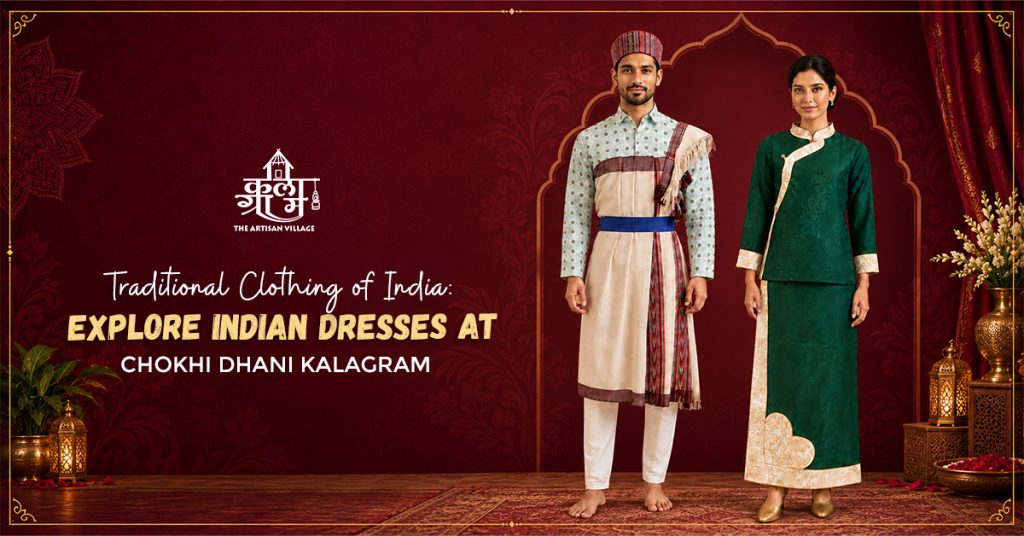
Kashmir’s men wear their own cut of the Pheran, paired with a traditional cap. Built for warmth first, it still holds up as formalwear once a wedding or festival comes around.
Fabric varieties: Wool, Pashmina, Tweed, silk
Best for: Winter wear; weddings and festive occasions
Shop Traditional Indian Clothing at Chokhi Dhani Kalagram
If you want to add any of these traditional clothing categories to upgrade your wardrobe, then look no further and visit Kalagram. It is the artisan marketplace inside Chokhi Dhani, and is considered as a no hassle cloth market in Jaipur than a conventional shop in busy markets. Every stall belongs to a different craft, with hand-block printed cottons, silk sarees and vibrant fusion of pieces inspired from both – a touch of modernity and ancient traditions of India.
Kalagram hosts a variety of distinguished stores for exclusive pieces of Indian textile craftsmanship.
Bunai Bazaar carries textiles pulled from across the country under one roof. Here, you’ll find Phulkari dupattas, Assam silk, Kashmiri and Northeast shawls, Kota Doria suits, Bhagalpur sarees.
Pahnaav is the ready-to-wear stop for those looking for stylish printed shirts, embroidered kurtis and stitched suits for different occasions.
The dedicated Pashmina store is for the lovers of heirloom finely crafted shawls, and Ashna Vaswani’s designer boutique showcases an elegant collection of Indian textiles with gota patti, intricate embroidery, and mirror work.
Compared to the famous markets in Jaipur, such as Bapu Bazaar, Johari Bazaar, and the rest- Kalagram is all about supporting the art and skill of experienced artisans. Here, you’re buying directly from the person who made it, not a shop reselling it. For anyone interested in Rajasthan clothing, or attires from different states of India, must explore this spot.
One single-entry ticket covers everything at Chokhi Dhani- Kalagram’s shopping, the cultural performances, the delicious food, all of it.
Whether you’re after a Bandhani dupatta, a block-print kurta set, or just want to see what traditional Indian clothing looks like before buying it online somewhere, Kalagram makes that decision easier.
FAQ's
What is the most popular traditional dress in India?
For women, saree and salwar kameez remains the most widely worn traditional garment across India, though its fabric and draping style change from state to state.
What is the traditional dress of Rajasthan?
Rajasthani women traditionally wear the Ghagra Choli, a flared skirt and fitted blouse, often in Bandhani or Kota Doria. Men wear the Angarkha with a Dhoti and Safa, the turban’s colour and style varying by district.
Where can I buy authentic Rajasthani clothing in Jaipur?
Chokhi Dhani Kalagram is a trusted option where you can explore authentic Rajasthani clothing in Jaipur. Since every stall is run by the artisan who made the pieces rather than a reseller, the prices are justifiable. Bapu Bazaar and Johari Bazaar are the city’s most famous markets, but be ready to bargain a lot.
Is Chokhi Dhani Kalagram worth visiting for shopping alone?
If you visit Kalagram for shopping purposes, you cannot come back without enjoying the complete Chokhi Dhani experience, as there’s so much to do in that space. One single-entry ticket also covers the cultural performances and the traditional Rajasthani feast, so most visitors spend a good time there instead of just shopping and coming back.